Saturday, September 9, 2023

Star Wars - Episode I: The Phantom Menace

I recently re-watched The Phantom Menace for research for my Star Wars blog, and it gave me an opportunity to develop a couple ideas I had.

During their dinner conversation, Padmé tells Anakin, "Our ship was damaged, and we're stranded here until we can repair it," and he replies, "I can help; I can fix anything."  His prodigious technical ability seems to be an attribute of his status as the Chosen One.  In the same way that he will restore balance to the Force, he can restore balance to mechanical systems and get them to work again.

Like Return of the Jedi, the title is ambigious.  There are three characters who could be "the phantom menace":  Anakin, who is only a child in this movie but will grow up to become Darth Vader and terrorize the galaxy; Palpatine, who uses his position as a senator to disguise his identity as a Sith Lord; and Darth Maul, who mysteriously appears in order to track down Queen Amidala and harrass her Jedi protectors.

Saturday, May 13, 2023

Metropolis

Earlier this week, I watched Metropolis for the first time in something like thirteen years.  I think previously I'd watched a rather low quality version I'd found on the internet, but this time I watched a DVD of a restoration from 2002.  In any case, I noticed a fairly trivial detail.

A little less than halfway through the movie, Maria tells the gathered workers about the Tower of Babel.


The image of the tower seems to be based on the painting "The Tower of Babel" by Pieter Bruegel the Elder from 1565 (it's called the "little" Tower of Babel to distinguish it from an-other painting Bruegel did):


Coincidentally, a day or two before I watched the movie, I'd read the account of the Tower of Babel in Genesis 11:1-9.  The version in Metropolis is somewhat different, though.  Here's the text from the intertitles:
Come, let us build us a tower whose top may reach unto the stars!

And on the top of the tower we will write the words:  Great is the world and its Creator!  And great is Man!

... but the minds that had conceived the Tower of Babel could not build it.  The task was too great.  So they hired hands for wages.

But the hands that built the Tower of Babel knew nothing of the dream of the brain that had conceived it.

One man's hymns of praise became other men's curses.

People spoke the same language, but could not understand each other...

"HEAD and HANDS need a mediator."

Saturday, April 29, 2023

National Treasure

A couple times over the last half a year or so, I was thinking about the names in National Treasure.  The FBI agents say the full names of two of the characters:  Benjamin Frankin Gates and Patrick Henry Gates.  In the credits, the grandfather's name is given:  John Adams Gates.  Obviously, they're named after figures from the American Revolution (similarly, Dr. Abigail Chase seems to have been named after Abigail Adams), but Ben Gates' name also fits with one of the other themes of the movie.

Benjamin (בִּנְיָמִין) is a Hebrew name that means "son of the right [hand]."  The shortened form Ben is the Hebrew word for son (בֵּן).  While the character in National Treasure is named after Benjamin Franklin, the etymological meaning of his name coincidentally illustrates the filial obligation he feels, not only to his ancestors but also to the Founding Fathers.  This is evident in the pledge that the grandfather devises for Ben early in the movie:  "Benjamin Franklin Gates, you take upon yourself the duty of the Templars, the Freemasons, and the family Gates."  In light of his name, it's also appropriate that the search for the treasure culminates in him, the son of his forefathers.  As Patrick says after they've found the treasure:  "We're in the company of some of the most brilliant minds in history because you found what they left behind for us to find and understood the meaning of it.  You did it, Ben.  For all of us.  Your grandfather and all of us."

Although it doesn't fit as well as Ben's name, Patrick's name also provides a hint of the father-son relationships in the movie.  The name itself means "noble," but it resembles patris, the genitive form of pater, the Latin word for father.

Saturday, March 25, 2023

Bones - S8E15 - "The Shot in the Dark"

Over the last few years, I've been slowly re-watching Bones.  Recently, I watched "The Shot in the Dark" (S8E15) and noticed a detail that's not particularly significant but that does provide a subtle connection between this episode and previous episodes that deal with Dr. Brennan's relationship with her mother.

After Dr. Brennan is shot, she has a number of visions in which she sees her mother.  In some of these, she's wearing a dolphin necklace:


In two previous episodes, Dr. Brennan comments on her mother's love of dolphins.  In "The Woman in Limbo" (S1E22), when her mother's remains are found in the Jeffersonian, she remarks, "I remember this belt buckle.  I borrowed it without asking.  First day of high school.  My father had it specially made for my mother because she loved dolphins."


In "Stargazer in a Puddle" (S2E21), she points out a drawing of a constellation in a murder victim's home and says, "This one's Delphinius [sic], the dolphin.  It was my favorite when I was a child.  My mother and I both loved dolphins, so that was something that we shared."

The dolphin necklace that she's wearing in this episode is never commented on, but it does provide a link to these earlier, related episodes.

Saturday, March 18, 2023

Star Wars: The Clone Wars - S5E19 - "To Catch a Jedi"

This post contains spoilers.

Recently, I re-watched the Star Wars: The Clone Wars episode "To Catch a Jedi" (S5E19) and noticed an interesting detail.  Near the end of the episode, Barriss Offee (whose identity isn't revealed until the next episode) steals Asajj Ventress's mask and lightsabers and, disguised as Ventress, attacks Ahsoka Tano.  During the fight, she slashes a pipe so that the resulting exhaust temporarily stuns Ahsoka.

At first, I thought this was just a reference to a similar event in The Empire Strikes Back, where Luke directs exhaust from a cut hose in the carbon freezing chamber at Vader, creating enough of a distraction so that he can retrieve his fallen lightsaber, but it actually has a closer analogue in an earlier episode of The Clone Wars, and this holds greater significance.

In "Cloak of Darkness" (S1E9), there's a lightsaber duel between Luminara Unduli and Asajj Ventress in which Ventress does the same thing:  she cuts a pipe in the Jedi cruiser so that the steam compromises Luminara's vision.  Ahsoka was present at the duel (albeit the later stages), and since Barriss is Luminara's padawan, it's likely that she's familiar with it, too.  In "To Catch a Jedi," she adopts this move as an-other facet of her disguise and an-other way to make Ahsoka believe that she is Ventress.

Saturday, March 4, 2023

Breaking Away

Last month, I watched this performance of Mendelssohn's Symphony No. 4 in A major, Op. 90, subtitled "Italian."  It reminded me that the fourth movement is used in the soundtrack of Breaking Away.  I'd realized before that there's a connection between the "Italian" symphony and the affinity of one of the main characters for all things Italian, but I had two more realizations about the use of this movement in the soundtrack.  Earlier this week, I watched the movie again to reacquiant myself with it.

Dave Stohler, one of the main characters, is obsessively interested in bicycle racing and the Cinzano team in particular.  About twenty-four minutes into the movie, after he's learned that the team is coming to race close to where he lives, there's a scene where he rides his bicycle down the highway as part of his training.  The fourth movement of Mendelssohn's symphony is used as the soundtrack here, and its "presto" tempo marking matches the ever increasing speed at which Stohler races and his urging himself to go "Faster!"

The other realization I had is that there's something of a similarity between Stohler's pretending to be Italian and Mendelssohn's writing a symphony inspired by Italy.  Of course, these aren't exactly the same, but common to both is this looking to a foreign culture.  Neither is the genuine article:  Stohler is American, not Italian, and the "Italian" symphony, unlike some of the veritable Italian music used in the film's soundtrack, was written by a German.

Saturday, February 4, 2023

Les Misérables

I've been (slowly) re-reading Les Misérables, although this is the first time I'm reading this particular translation (by Julie Rose) and the first time I'm reading an unabridged edition.  Recently, I read Chapter VI ("Father Fauchelevent") of Part One, Book Five, and this reminded me that the movie treats this scene differently and that I'd intended to write about it years ago.  Earlier this week, I watched the movie again so I could write about it.

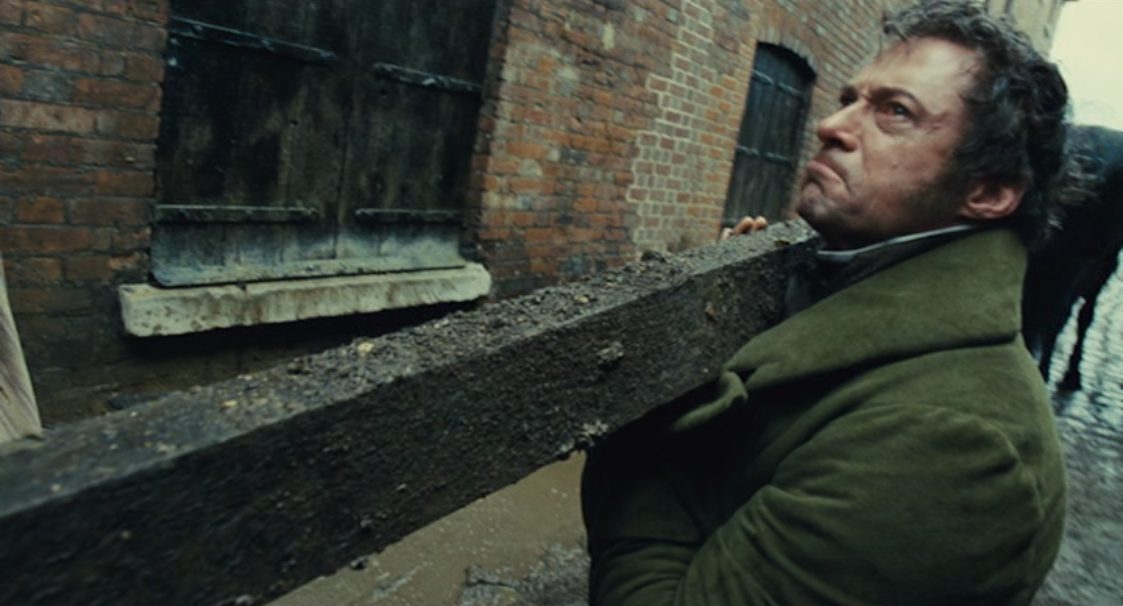
In both the movie and the book, Jean Valjean, in the guise of Monsieur Madeleine, comes upon Fauchelevent, who is trapped under his cart and slowly being crushed by it.  In the movie, Valjean, with the aid of a beam he uses as a lever, lifts the cart off of Fauchelevent:


Javert witnesses this feat and afterwards starts to suspect that Monsieur Madeleine is really Jean Valjean, whom he knew as prisoner 24601 and whose great strength he witnessed in an earlier scene where Javert has Valjean retrieve the flag, which was still attached to a mast:


(In addition to this visual parallelism, the two scenes are underscored by the same music.)

In the movie, the main purpose of this scene with Fauchelevent's cart seems to be the stirring of Javert's suspicion.  The demonstration of Valjean's compassion and setting up Fauchelevent's later repayment of this kindness are minor in comparison.  In the book, however, this scene is a bit different and primarily illustrates Valjean's character.

In the movie, Javert becomes suspicious about Madeleine's true identity only after he lifts the cart, but in the book, he makes it clear that he remembers Valjean's strength beforehand.  In Chapter VII ("Despair from the Inside") of Part One, Book Two, the narrator explains that "not one of the galley inmates could hold a candle to him in physical strength.  In hard labor, for twisting a cable or turning a windlass, Jean Valjean was equal to four men.  He would sometimes lift and carry enormous weights on his back and would occasionally himself replace the tool known as a cric, or jack... His inmate pals had nicknamed him Jean-le-Cric."

In Chapter VI ("Father Fauchelevent") of Part One, Book Five, after Valjean offers increasingly larger sums of money to any man who will get under the cart to lift it off Fauchelevent, Javert remarks:  "You'd have to be a monster of a man to lift a cart like that on your back. ... Monsieur Madeleine, I have only ever known one man capable of doing what you're asking here. ... He was a convict. ... From the jail in Toulon. ... I've only ever known one man who could stand in for a jack.  And it was that convict."

Despite these comments, Valjean gets under the cart and lifts it off Fauchelevent, basically admitting that he is the man whom Javert remembered.

The other significant difference is that in order to save Fauchelevent, Valjean puts himself in the same perilous position, even though, as the narrator explains, Fauchelevent is "one of the rare enemies Monsieur Madeleine still had" and that he "had done everything he could to hurt Madeleine" in terms of his business.  Valjean remains there, trying to lift the cart, even though the crowd in general and Fauchelevent specifically try to persuade him to get out.

The scene in the movie shows Valjean simply doing a good deed that has unintended consequences, but the stakes are much higher for him in the book, where he puts himself at risk by going under the cart and he knowingly stokes Javert's suspicions, all for the sake of a man who is his enemy.  Valjean's saving Fauchelevent under these conditions illustrates his extreme selflessness.