Saturday, May 23, 2020

Star Wars - Episode V: The Empire Strikes Back

The 21st was the 40th anniversary of the release of The Empire Strikes BackAccording to IMDb, however, the premier was on the 17th.  I watched my DVD copy from 2013 (the special edition) on the 17th, and then I watched my VHS copy from 1995 on the 21st.  I don't think "non-special edition" copies are even available anymore, and/so I thought it would be interesting to write a post about some of the differences.  This isn't meant to be an exhaustive list; these are just things I noticed as I watched it.

In the special edition, while Luke is hanging from the ceiling of the wampa's cave, there are cut away shots to the wampa eating Luke's tauntaun.  In the original, there are just noises of the wampa's growling and of the tauntaun's being strangled and a quick shot of the wampa walking.

After Luke's time recovering in the bacta tank, C-3PO says to him, "Master Luke, sir, it's so good to see you fully functional again.  R2 expresses his relief also."  In the special edition, Luke replies, "Thanks, 3PO" but he doesn't say anything in the original.

Shortly before the Millennium Falcon enters the "cave" in the asteroid, C-3PO says, "Oh, this is suicide."  In the original version, that's his only comment, but in the special edition, he follows it with "There's nowhere to go."

Vader's conversation with the Emperor contains some of the most notable differences between the two versions.  Here's the original version:
Vader:  What is thy bidding, my master?
Emperor:  There is a great disturbance in the Force.
Vader:  I have felt it.
Emperor:  We have a new enemy:  Luke Skywalker.
Vader:  Yes, my master.
Emperor:  He could destroy us.
Vader:  He's just a boy.  Obi-Wan can no longer help him.
Emperor:  The Force is strong with him.  The son of Skywalker must not become a Jedi.
Vader:  If he could be turned, he would become a powerful ally.
Emperor:  Yes, yes, he would be a great asset.  Can it be done?
Vader:  He will join us or die, master.
And the original Emperor (with VHS quality and aspect ratio):


Here's the version from the special edition:
Vader:  What is thy bidding, my master?
Emperor:  There is a great disturbance in the Force.
Vader:  I have felt it.
Emperor:  We have a new enemy.  The young rebel who destroyed the Death Star.  I have no doubt this boy is the offspring of Anakin Skywalker.
Vader:  How is that possible?
Emperor:  Search your feelings, Lord Vader; you will know it to be true.  He could destroy us.
Vader:  He's just a boy.  Obi-Wan can no longer help him.
Emperor:  The Force is strong with him.  The son of Skywalker must not become a Jedi.
Vader:  If he could be turned, he would become a powerful ally.
Emperor:  Yes, he would be a great asset.  Can it be done?
Vader:  He will join us or die, master.
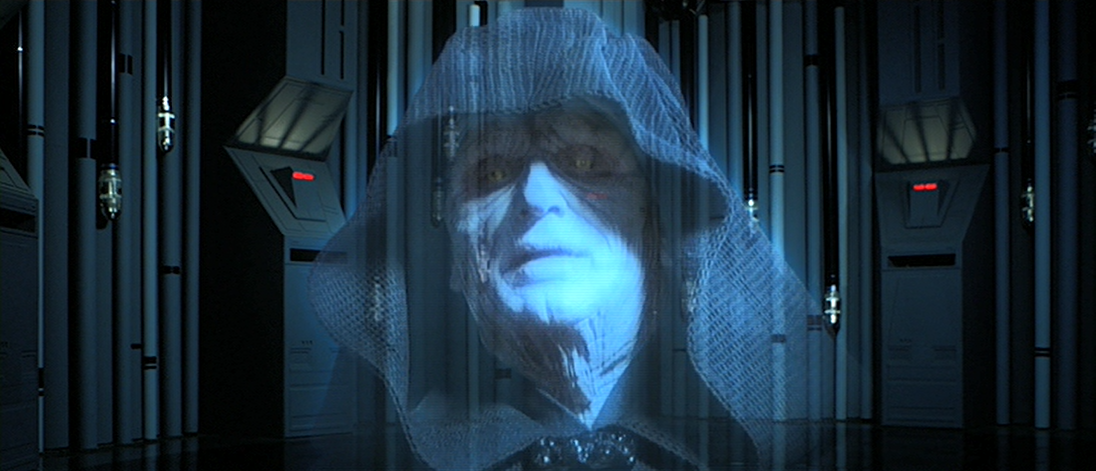
In the special edition, there are new shots of Ian McDiarmid as the Emperor:


It seems that Temuera Morrison, who played Jango Fett and the clone troopers in Attack of the Clones and Revenge of the Sith, similarly dubbed over new recordings of Boba Fett's lines.  Morrison isn't listed in the credits for the special edition (nor is McDiarmid), so I'm not positive it's him, but Fett's voice certainly is different.

There are various sequences in Cloud City that have been expanded.  The Millennium Falcon's landing has new shots, and there's a completely new sequence in which a cloud car flies through the city.  This eventually transitions back into the original shot of the cloud car flying past the window where Leia is standing.  There are also some shots where colored panels have been replaced with new digital backgrounds.  One of these alterations actually results in a continuity error.  In the scene where Lando is talking about his facility "like a businessman, a responsible leader," there are colored panels at the end of the hallway:


In the special edition, these have been replaced with a view of the city:


In the next shot, Lando and Han pause at the end of the hallway, but instead of the view of the city, the colored panels are behind them:


The special edition changed one shot but not the other.

One of the oddest things I noticed is that one of Vader's grunts in his lightsaber battle with Luke is copied and re-used.  After Vader's line "Impressive, most impressive," Luke directs exhaust from a recently cut hose at him.  His grunt is a solid UNG!  A few shots later, Luke manages to knock Vader off of the carbon freezing platform.  In the special edition, this UNG! is re-used, but in the original, Vader lets out a guttural and raspy AAH!

After Leia convinces Lando and Chewbacca to go back to Cloud City to rescue Luke, there's a quick shot of Vader, an imperial officer, and some stormtroopers in which - in the original version - Vader says simply, "Bring my shuttle."  In the special edition, he says, "Alert my Star Destroyer to prepare for my arrival."

I also noticed that in the original version, some of the TIE fighters' lasers are either blue (in the asteroid field) or white (while chasing the Millennium Falcon out of Cloud City), while in the special edition, they're all green.  And a very minor point:  in the original release, Obi-Wan is written as "Obi-wan" in the credits.

Saturday, May 16, 2020

Cast Away

This post contains spoilers.

Earlier this week, I watched Cast Away for the second time, and I noticed how two scenes from different points in the movie illustrate a change in Chuck's character.

(For context: in the scene immediately preceding the first conversation, a flight attendant asks Chuck's friend Stan about his [Stan's] wife's cancer diagnosis.)

In the first conversation, Chuck and Stan sit on opposite sides of a transport vehicle (at times facing nearly opposite directions), and Chuck tries to offer a helpful word regarding Stan's wife's cancer.


Speaking haltingly and veering off on an unrelated tangent, he tells Stan about a renowned doctor whom he's going to try to get Stan and his wife in touch with.  Stan's reaction is polite yet disappointed, and his posture is one of defeat.

After Chuck's isolation on the deserted island, he has an-other conversation with Stan while in an airplane travelling to a press conference.


After realizing that Stan went through Chuck's funeral and then his wife Mary's funeral, Chuck offers heartfelt words:
Stan, I'm so sorry I wasn't around when Mary died.  I should've been there for you, and I wasn't.  I'm so sorry.
While Stan still seems sad about his wife's death, he smiles at Chuck's expression of compassion.

There are four significant differences between these conversations.  First, the settings:  the first conversation is static; while Chuck and Stan are sitting on a transport vehicle, it's not moving.  The second conversation takes place within a moving plane and is dynamic.  Second, the characters' positions:  Chuck and Stan are almost facing away from each other in the first conversation, but the second is more face-to-face.  Third, Chuck's comments:  in the first conversation, he's trying to show his compassion for his friend, but he does so by trying to fix Stan's problem for him.  In the second conversation, he simply expresses his feelings.  And fourth, Stan's reactions:  after the first conversation, he almost seems to resent Chuck's suggestion of an-other doctor, but after the second, he's clearly glad to have his friend back.

Obviously, the cause of these differences is the time that Chuck spent on the island.  Being isolated led him to reëvaluate his personal connections, and now he holds them in greater esteem.

[Here's a post I wrote after I watched Cast Away for the first time.]

Saturday, March 28, 2020

Star Wars: The Clone Wars - S6E6 - "The Rise of Clovis"

About a year ago, I watched the Banking Clan arc of Star Wars: The Clone Wars (episodes 5 through 7 of season 6), and the following month, I realized some implications of a grammatical error that Padmé makes in episode 6, "The Rise of Clovis."

After Clovis repeatedly asks about the relationship between Padmé and Anakin, Padmé asserts that "there is nothing romantic between he and I."  The pronouns "he" and "I" are in the wrong grammatical case here; they should be "him" and "me."  Padmé's misuse of these pronouns illustrates that she's flustered because of Clovis' suspicion - or perhaps even discernment - of the romantic relationship that does indeed exist between the two.  It's also significant that Padmé separates herself from Anakin here; she says, "he and I" and not "us."

I should note that by no means do I expect characters' grammar to be perfect all of the time.  After all, some looseness in language is what makes dialogue seem realistic.  Since Padmé is a senator, however, and presumably has a high quality education, this is out of character.  The above is my in-world explanation, but it's likely that this error is simply the fault of the writer (Christian Taylor).  Earlier in this scene, Clovis makes the same error:  while searching through files in order to find out where missing funds have gone, he tells Padmé, "Whatever we find must remain between only you and I" (rather than "between only you and me").

For what it's worth, Obi-Wan Kenobi makes a similar error in "Hunt for Ziro" (S3E9, written by Steve Mitchell & Craig Van Sickle) when he tells Quinlan Vos, "As for this bounty hunter, Cad Bane, we must capture and return both he and his quarry Ziro to the courts."  "He" should be "him."

---
I've also written about the other two episodes in this arc:  "An Old Friend" and "Crisis at the Heart."

Saturday, March 14, 2020

Indiana Jones and the Last Crusade

I recently watched Indiana Jones and the Last Crusade again and noticed a small but significant detail.

I'd noticed before that there's something of an echo between the beginning and end of the film.  At the beginning, as he's copying an image from an illuminated manuscript, Dr. Jones, Sr. says, "May he who illuminated this illuminate me."  (With a double meaning on illuminate, which is where I got the name of this blog.)  At the end, when the adventure is all but over, Indiana Jones asks his father, "What did you find, dad?" and Dr. Jones, Sr. replies, "Illumination."

Watching the film this time, I noticed a third instance of this illumination.  During the chase through the catacombs under the library and through the canals of Venice, Indiana Jones and Dr. Elsa Schneider run past a sign that reads:  "Calle di S.ta Lucia."

Here are two frames (one is more legible, and one shows the characters a bit better):


"Calle di S.ta Lucia" means "St. Lucia's Lane."  St. Lucia is the patron saint of sight, and her name is related to words for light (such as luce in Italian and lux in Latin).  Taken with "lane," this seems to indicate that the characters are on their way - travelling along the path, as it were - to the illumination that occurs at the end of the film.  Since, however, Elsa certainly doesn't find illumination and Indiana Jones doesn't answer what he's found (instead, he quibbles about being called "Junior" again), the sign actually seems to apply more to Dr. Jones, Sr. or even to the audience.

Saturday, December 7, 2019

Flyboys

I recently watched Flyboys (I think for the third time).  While I think the movie has some problems, I did notice an interesting feature of the composition of the shots during the one sequence that shows the front (when Beagle's plane crashes and Rawlings lands in order to help him).

Aside from shots looking straight from one side to the other (that is, from the perspective of the French soldiers, across No Man's Land, to the German trench or vice versa), the shots of the Germans show them looking left:


And the shots of the French show them looking right:


Not only does this give a visual sense of opposition, but it also shows that the Germans were trying to advance to the west and that the French were trying to push them back east.

Saturday, January 5, 2019

The Terminal

A couple weeks ago, I re-watched The Terminal and noticed that - in a way - Viktor Navorski's encounter with Mr. Milodragovich illustrates Navorski's chief motivation for the whole film.

Mr. Thurman's explaining the situation to Dixon summarizes the scene well: "When the 9:12 from Toronto landed, they found four prescriptions without an MPL [medicinal purchase license].  They tried to take the pills away from him, and he went nuts.  There he is.  We think they're for his father."  The interpreter is an hour away, and Thurman has the idea to use Navorski as a translator.

At first Navorski explains that Milodragovich says that the medicine is for his father, but when it seems that the medicines are going to be taken away from Milodragovich because he doesn't have the correct documentation, Viktor stops everyone and says, "I make mistake."  The medicine is actually for a goat.  Dixon is suspicious of this and accuses Viktor of cheating the system.  He says Viktor has been reading the forms, specifically "the one that says if it's an animal, he doesn't need the medicinal purchase license."  In the end, Milodragovich himself says "Medicine for goat" and is allowed to take the pills with him.

When I watched the film previously, I thought this scene simply illustrates Navorski's compassion for others.  He sees that Milodragovich is in a difficult situation, so he helps him out of it.  When I watched the film again recently, however, I realized that the scene has a deeper meaning than that.  Navorski identifies with Milodragovich's mission to procure medicine for his ailing father because Navorski made a promise to his own father that he would collect the last signature from the group of jazz musicians in the photograph.  While Navorski's compassion certainly influences his actions here, his paternal dedication - a quality that he sees in Milodragovich - is also evident.

Saturday, November 10, 2018

Cars

I recently re-watched Cars.  Since the last time I saw it a number of years ago, I started learning Italian, and I wanted to see how much of the Italian in the movie I could understand.

I also noticed a few visual details that I'd missed before.  Near the beginning of the movie, as part of the in-world Racing Sports Network program, the point totals of Strip Weathers, Chick Hicks, and Lightning McQueen are shown, with lines linking the data boxes to the cars, but the line for Chick Hicks isn't as centered as those for Weathers or McQueen:


The skewed line visually represents Hicks' skewed outlook; he's focused only on himself.

I also started wondering if Hicks' number is related to the expression "to eighty-six it," meaning to throw something away.  I couldn't develop an argument for this, but I thought I'd mention it anyway.

An-other small detail I noticed is the Latin motto above the door in traffic court in Radiator Springs:

Justitae via strata veritate

I translated this as: A road of justice leveled by truth.

Here's how I parsed it:
Justitae - noun, 1st declension feminine, genitive singular - "of justice"
Via - noun, 1st declension feminine, nominative singular - "road"
Strata - perfect passive participle from sterno, sternere, stavi, stratum - nominative, feminine singular - "leveled"
Veritate - noun, 3rd declension feminine, ablative singular - "by truth"

Appropriate to the world of the movie, this motto uses a road as a metaphor.

Guido's name is also something of a hidden reference.  As a regular word, guido means "I drive" in Italian; it's from the verb guidare.