Saturday, June 11, 2016

Grimm - S4E16 - Heartbreaker

Originally, for this episode of Grimm, I had a vague idea about a visual element and its connection to the particular Wesen that the episode features, but after re-watching it recently, I revised that notion, noticed a lot of new things (many just in writing this post), and realized that what I thought was an error in my comprehending dialogue actually illustrates some character traits.

There's a lot in this episode.

First, I have a few points for which a short summary about the Wesen in this episode is critical.  When Nick and Hank talk to Monroe and Rosalee about the murder they're investigating (for which they - and Sergeant Wu - suspect Wesen because of the rare toxin involved), Rosalee posits that they're dealing with a Folterseele.  "They're kind of classically tragic.  Always beautiful, always deadly."  They woge when someone is attracted to them, and - as Monroe puts it when Hank compares it to "the old Frog Prince story" - "Yeah, but you kiss this frog, your face blows up and you die" because of the toxin, which works as a defense mechanism.

Until writing this post, I hadn't lookt into the name of this particular Wesen.  Seeing Folterseele in the closed captioning, I recognized Seele as German for soul, but I had to look up Folter.  Die Folter is the torture.  I think Folterseele is supposed to evoke something like tortured soul, although gefolterte Seele is a more accurate translation.  In any case, it perfectly encapsulates this Wesen.  They keep to themselves to avoid effecting this defense mechanism.  As Bella Turner (the Folterseele in this episode) explains later: "You don't know what it's like to never be able to experience love.  Never feel the touch of another person or be able to touch them."

This brings up what should have been obvious to me when I first watched this:  Bella's name also describes the Folterseele's situation.  Bella means beautiful in Latin.  Half of Rosalee's "Always beautiful, always deadly" description of Folterseele is literally in Bella's name.

Turner is part of a bicycling group, which I think the writers employ as an updated version of a spinster.  Merriam-Webster recently had an article about the origin of the term, explaining that unmarried women were poorer and that spinning wool was one of the few jobs that they could acquire.  Instead of spinning wool, the spinning here is the spinning of bicycle wheels:


To further connect the two ideas, in Bella's apartment, which is shown only briefly, there's a bicycle wheel positioned in such a way that it resembles a spinning wheel:


The Turner part of her name also seems to play into this.  There's the literal turning, referring to spinning wheels, but there's also a more metaphorical turning involved.  At the end of the episode, she drinks a sort of potion that Monroe and Rosalee made in order to prevent the secretion of the toxin.  In a way, she's turning away from being a Folterseele.

The other interesting thing I noticed in this episode pertains to the Royal Family story line.  Prince Viktor was recalled to Austria in the previous episode, and his replacement Prince Kenneth arrives in this episode.  Rispoli (the assistant who asserts he's "loyal to the family, not to any particular member") tells Adalind that she should change into something more appropriate than a bathrobe for Kenneth's impending arrival.  Adalind asks, "Prince Kenneth?  Do you know him?" to which Rispoli answers, "By reputation."  He ushers Adalind into a room to change as she asks, "What's he like?"  In the few seconds it takes for Rispoli to close the door before he answers, I understood this as "What is he like?" both times I've watched the episode.  Because Adalind just asked, "Prince Kenneth?  Do you know him?" her question has the sense of "What kind of character does he have?" or "What kind of person is he?"  In her dealing with Prince Viktor, Adalind started to be a little manipulative, so here it seems like she's asking Rispoli about Kenneth's strength of will, to see if she can wrap him around her finger too.

However, Rispoli's answer changes how Adalind's question is understood.  He replies, "Results," which renders her question as "What does he like?"  To some degree, this shows the same quality in Rispoli's character that his assertion of family loyalty illustrated earlier in the same scene.  He has the mind-set of a servant who wants to please his superior, so he knows Prince Kenneth's preferences, despite knowing him only "by reputation."  While Kenneth hasn't even arrived yet, his coming reveals traits in these two, already-familiar characters.

Saturday, June 4, 2016

Grimm - S4E14 - Bad Luck

This post contains spoilers.

After a couple months of hiatus (because I've been busy), I've continued re-watching season four of Grimm.  I noticed what I think is a subtle reference to Beatrix Potter's The Tale of Peter Rabbit in episode 14 - "Bad Luck."

At the very beginning of the episode, a boy named Peter is murdered.  Peter is a Willahara, and a Leporem Venator hunts him down to cut off his foot, which is believed to help with fertility.  As Nick explains to Hank and Wu after seeing Peter's mother woge, Willahara are "rabbit-like" Wesen:


The name Peter and being a rabbit is common to both, but in reading The Tale of Peter Rabbit, I found something else.  Mrs. Rabbit tells her children, "You may go into the fields or down the lane, but don't go into Mr. McGregor's garden: your Father had an accident there; he was put in a pie by Mrs. McGregor."  In the show, Peter's father also had an accident (which appears to have been orchestrated by the Leporem Venator to acquire the father's foot too).

Most of the show is based on the fairy tales by the Grimm brothers, so it seems likely that Potter's tale, which has some similarities, was used as inspiration for this particular episode.

Saturday, February 20, 2016

Grimm - S4E11 - Death Do Us Part

I'm still re-watching season four of Grimm.  Recently, I re-watched "Death Do Us Part," remembered something I noticed when it originally aired, and found something new.

There's a murder at an abandoned house (with the same MO as two earlier murders in the same house), and Nick and Hank talk to Mark Wilson, the detective who investigated the original case.  He explains that he thought it was a love triangle.  "During the investigation, we learned Patty Donovan was having an affair with her husband's co-worker, Theo Hinkley.  Well, Theo probably thought Patty was gonna leave Stetson for him.  But Patty decided not to, so, Theo figured if he couldn't have her, no one could."  And then he says, "Shakespearean, ain't it?"


I'm not sure how much stock I would put in his "Shakespearean" assessment, but what I thought interesting about that line is that isn't not the only Shakespeare reference in the episode.  Or at least I don't think so.

Two scenes later, Nick gets into bed with Juliette and asks her, "What are you reading?"  To which she replies, "A book."


That same literal answer is in Shakespeare's Hamlet.  In Act II, Scene II, Polonius asks Hamlet, "What do you read, my lord?" and Hamlet replies, "Word, words, words."  (II.ii.209-210).

There doesn't seem to be much in-show significance, but I think it illustrates that the writers were indeed thinking of Shakespeare.

The new thing I noticed in re-watching it recently is that the same effect from "Wesenrein" (S4E9) returns.  At the end of this episode, when Juliette goes to visit Henrietta, her face is multiplied as the camera looks through a pane of glass with bevels at the edges:


As it did in "Wesenrein," it indicates how Juliette is starting to splinter between her normal self and her new hexenbiest self.

Saturday, February 13, 2016

Grimm - S4E10 - Tribunal

I recently re-watched the Grimm episode "Tribunal" and remembered something that I noticed when it first aired but had forgotten about.  Sergeant Wu is still learning about Grimms and Wesen, and before he sees his first woge (knowingly, at least), Hank talks to him.


Hank says, "You have to be ready for this," to which Wu responds, "And by ready you mean off the deep end?"  In his answer, Hank mixes metaphors:  "There is no shallow end in this pool.  This is not something anybody can wrap their head around until they have no choice but to get on board."

To some degree, having those three different descriptions (a pool, wrapping heads around, and a train) indicates the confusion and "other-ness" associated with knowing about the wider world of Grimms and Wesen.  There's no simple comparison to be made.  Like Hank tells Wu:  "You have to get a place where this is a new normal."

Saturday, February 6, 2016

Grimm - S4E9 - Wesenrein

This post contains spoilers.

Recently, I've been re-watching season four of Grimm, and I noticed something in episode nine - "Wesenrein."

At the end of the previous episode - "Chupacabra" - Juliette discovered that the headaches and nausea she's been experiencing were portends of her becoming a hexenbiest.  Episode nine continues where episode eight left off, right after this discovery.  Juliette starts to call Nick but stops the call before it goes through and then looks at herself in the mirror:


Because of the bevel in the mirror, she appears to have two faces, so her new nature is visualized.  There's Juliette, and then there's the hexenbiest that she's become.

Later, after she woges again (or, more accurately, nach sie wogt wieder), the glass in picture frames breaks, and the mirror shatters.  When she looks at it this time, her reflection also appears shattered:


Again it's visually demonstrated how her turning into a hexenbiest has affected her and will affect events later in the series.

Saturday, December 19, 2015

Toy Story That Time Forgot

Because it's getting close to the holiday season, Toy Story That Time Forgot has been on television fairly often in the last few weeks.  I was going to watch it two weeks ago, but then I discovered that last year I'd taped it off television (or whatever the digital equivalent of taping is).  I watched that instead (no commercials!), and I noticed what I think is a reference to Star Wars - Episode VI: Return of the Jedi.

In an arena-style battle, the battlesaurs release the Goliathon, who then eats Woody and Buzz.  For a few seconds, Woody's arm is shown sticking out of the Goliathon's teeth:


(Because I taped this off television, the quality's not that great.)

This same thing happens in Return of the Jedi, after the rancor eats a Gamorrean guard.  The guard's arm sticks out, and the rancor slurps up the rest of it as he turns to face Luke Sywalker:


(I have only the full screen edition of Return of the Jedi.)

Both creatures are positioned in the frame the same way (that is, they're looking the same direction), and the shape of their heads is fairly similar.  It's mostly just a mouth, with some tiny eyes just above it.

Beyond the visual similarity, there's something else that makes me pretty confident that this is an intentional Star Wars reference.  Earlier in Toy Story That Time Forgot, the Cleric comments on how Woody, Buzz, Rex, and Trixie have no armor:  "I find their lack of armor disturbing."  There's a very similar line in Star Wars -  Episode IV: A New Hope: "I find your lack of faith disturbing."

Saturday, December 5, 2015

Toy Story 2

This post contains some spoilers.

Last week, after I watched Toy Story, I watched Toy Story 2 (coincidentally on the sixteenth anniversary of its release [24 November 1999], just as I'd knowingly watched Toy Story on its twentieth anniversary).  I don't think I'd seen Toy Story 2 as recently as I had Toy Story, so there was a lot more that I didn't remember.  I found some new stuff too.

This might be obvious but I didn't notice until watching it this time that some of the elements of Zurg's fortress are marked with Zs.  When the ground gives way under Buzz, the negative space around the prongs form a Z:


After he drops through, the light shining down also marks out a Z:


The floor tiles (in the foreground below) are hexagons with a Z in the middle:


The second thing I noticed is that when Woody's arm gets ripped, there's a dramatic change in lighting.  Immediately after it's happened, before Andy has really had time to react, it's still bright and sunny from when Woody and Buzz saved the day in Andy's imaginary situation:


But once Andy realizes what's happened, it turns dark:


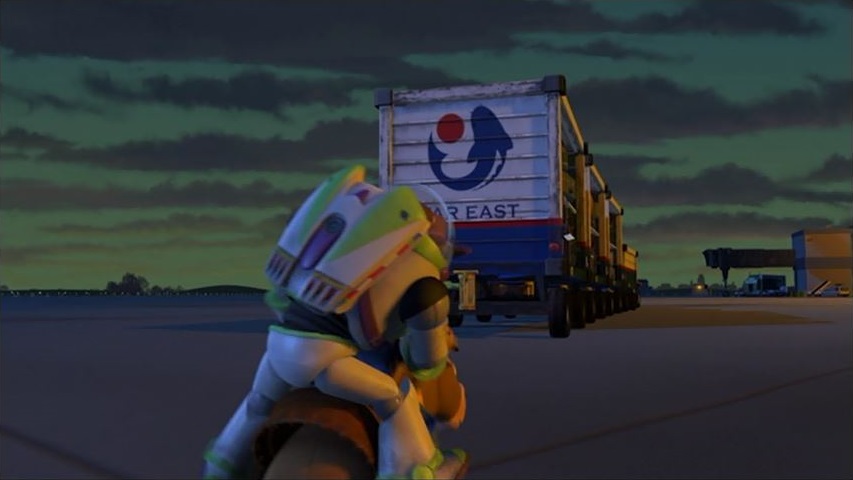
The last thing I noticed was the western flavor of Woody, Buzz, and Bull's Eye's chase after Jessie on the luggage cart at the airport.  In many ways, it's like a traditional train car robbery (so in some ways, it's reminiscent of Woody's Round-up from earlier in the movie).  They have to catch up to the luggage cart, and Woody has to get from Bull's Eye to the cart while everything is moving, like a bandit jumping from his horse onto a train:


Then, Woody has to climb over three semi-enclosed carts (like train cars) to an open cart (like a tinder car).  The tractor at the front is like the engine: