Saturday, August 28, 2021

Star Wars - Episode V: The Empire Strikes Back

Back in May, I started a blog focused on Star Wars.  I plan eventually to copy most of the Star Wars-related posts I've written here to that blog, but for now, I'm re-watching The Clone Wars (again) and pedantically noting references to the original movies.  It'll take me quite a while to get through that part of the project, so, for the time being, any significant Star Wars comments I have will appear here.

I watched a bit of The Empire Strikes Back recently in order to verify a bit of dialogue and find the time stamp for it, and I noticed a detail in the set.  Last May, I wrote a post about differences between the original version of the film and the special edition, and one feature I mentioned was these panels in the background of Cloud City:


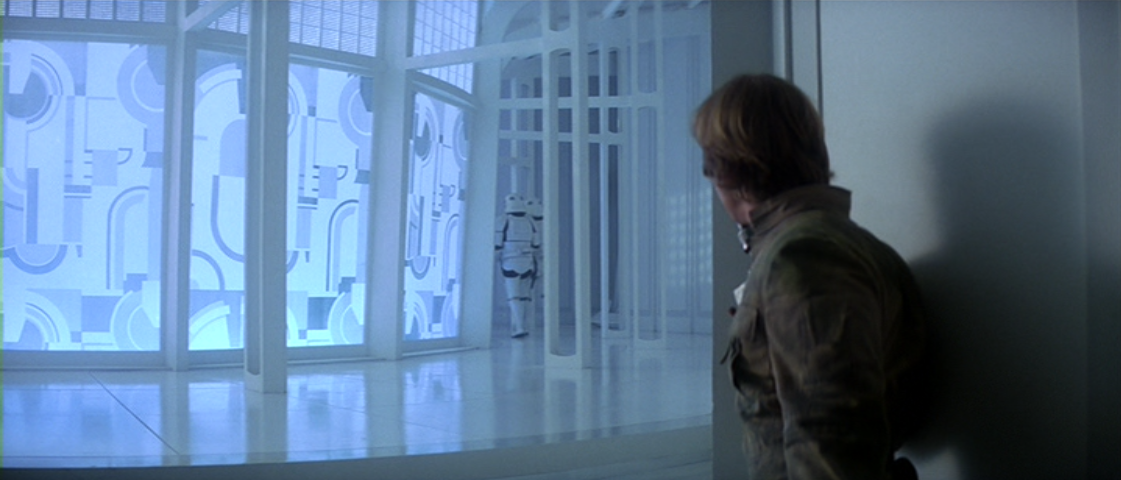
When Han, Leia, Chewbacca, and C-3PO arrive, these panels have a warm glow behind them.  By the time Luke arrives, however, after the Empire's trap has been sprung, this warmth has disappeared, and the panels are colorless:


This contrast in color illustrates the change that has occurred.  At first, Cloud City seems like an inviting place, but once the Empire's presence is revealed, it becomes a stark and unwelcoming environment.

Saturday, August 14, 2021

The Sound of Music

I recently watched The Sound of Music and noticed a small (and possibly just coincidental) connection between the movie's opening and Psalm 121:1, which is quoted by the Reverend Mother near the end of the movie.  The way she says it, it sounds like a statement:  "I will lift up mine eyes unto the hills from whence [sic] cometh my help."  I'm more familiar with it as a question:  "I lift up my eyes to the hills.  From where does my help come?"  This is answered by the following verse:  "My help comes from the LORD, who made heaven and earth."

The Psalm starts with the Psalmist looking at the hills, and in more ways than one, the movie also starts with hills.  Visually, it opens with multiple establishing shots of mountains and hills, and musically, it starts with the line "The hills are alive with the sound of music."

Saturday, August 7, 2021

Willy Wonka & the Chocolate Factory

I was thinking about the names of the children in Willy Wonka & the Chocolate Factory recently.  I had a notion (admittedly, a rather far-fetched one) about the significance of these names, so I re-watched the movie (for the first time in about ten years) in order to develop my argument.

The five children who find Wonka's golden tickets are Augustus Gloop, Veruca Salt, Violet Beauregarde, Mike Teevee, and Charlie Bucket.  Along with being the main character, Charlie Bucket is significant in that his name is evenly balanced:  his first name is two syllables, and his last name is two syllables.  The names of the other children don't have this feature.

This balance of Charlie's name illustrates something of his character, although this is demonstrated more clearly in his contrast with the other children.  All of the other children are selfish, but this selfishness is manifested in different ways.  Augustus Gloop and Veruca Salt are simply greedy.  Augustus is constantly eating, and Veruca is always demanding things (primarily from her father).  Violet Beauregarde and Mike Teevee are more concerned with acquiring other people's attention.  When she's interviewed after finding the golden ticket, Violet makes sure to mention the world record that she's won, and on more than one occasion, she pushes her father away from the camera's lens so that the attention is directed solely on her.  Mike Teevee's selfishness doesn't really present itself until he's in the factory.  After he sees how Wonka transmits a bar of chocolate through the television, however, nothing will stop him from "be[ing] the first person in the world to be sent by television!"  He wants this claim to fame.

Charlie doesn't act selfishly, and occasionally, he even inquires about the welfare of the other children.  He questions Wonka about Veruca and her father ("They won't really be burned in the furnace, will they?"), and at the end of the tour, he asks, "What's gonna happen to the other kids?  Augustus?  Veruca?"  When Augustus falls into the river of chocolate, Charlie even tries to help him get out by extending a giant lollipop for him to grab.

At the end of the movie, Wonka calls Charlie "a very honest, loving child," and he clearly stands in stark contrast to the other children.  While their behavior is the most obvious indication of this, their names point to this too.  The syllables of Charlie Bucket's name are evenly balanced, but the names of the other children are imbalanced in the same way that their personalities are.

Saturday, June 5, 2021

The Ray Bradbury Theater - "The Emissary"

A few years ago, I got a box set of The Ray Bradbury Theater (which I'd been unaware of until I saw it in the store), but I didn't start watching the series until Bradbury's hundredth birthday last year (on 22 August).  Recently, I watched an episode titled "The Emissary," and I think the ending could be taken in two different ways.

This post contains spoilers.

The episode is about Martin Bailey who is basically confined to bed because of an illness that the episode never specifies.  His dog, apparently named just Dog, helps him to learn about the outside world by bringing various items back to him.  Early in the episode, it brings back a variety of leaves and plants, and these allow Martin to determine where the dog has been.  One day, Martin attaches a sign to the dog that reads, "Martin Bailey owns me.  Sick in Bed.  Needs company.  Follow me."  The dog returns with Miss Haight, who would have been Martin's teacher had he been well enough to attend school.  Over the next few weeks, Miss Haight regularly visits, always announcing herself with a cheery, "Company!" and bringing Martin a variety of books to read.

After Miss Haight is suddenly killed in a car accident, Martin becomes preoccupied with thinking about the dead, specifically how "it doesn't seem like much fun" for the corpses simply to lie underground.  He asks his parents, "Why don't they jump up and run around once in a while?"

Shortly after Miss Haight's funeral, Dog disappears and is missing for a day.  On the evening of what is apparently Halloween, it returns, and when Martin examines it to see where it's been, he finds mud and worms.  As he asks the dog where it's been digging, the lights in his room go out.  A glow comes from the doorway where a hand pushes open the door and a voice announces, "Company!"

Taken one way, this could be precisely the thing that Martin has been thinking about:  the dead "jump[ing] up" out of their graves and "run[ning] around."  In this case, Miss Haight is dug up by Dog, and she visits Martin once again.

Since Martin has some sort of illness, however, it's also possible to view these events as hallucinations that he experiences as he dies.  The dog doesn't really return covered with mud, and the hand of a corpse doesn't really push open the door to Martin's bedroom.  His illness and his preoccupation with the dead simply make him believe these things in his final moments.

Miss Haight's last words to Martin were "Hurry up!  I'll be waiting," so the "Company!" that he hears at the end of the episode could be upon his meeting her in the afterlife, not her coming back to his bedroom.

Saturday, January 30, 2021

A Bug's Life

This post contains spoilers.

I recently re-watched A Bug's Life and noticed a detail in one scene.

Near the end of the movie, the ants realize that they're stronger than the grasshoppers if they work together.  As a visual representation of this solidarity, there's a shot that's composed almost entirely of ants, with hardly any glimpse of a background or anything else.  Here are two frames:


Saturday, August 15, 2020

Wonder Woman - S1E9 - "Judgment from Outer Space Part I"

Recently, I started watching the Wonder Woman series for the first time.  Earlier this week, I watched the two-part episode "Judgment from Outer Space" (episodes nine and ten of the first season).

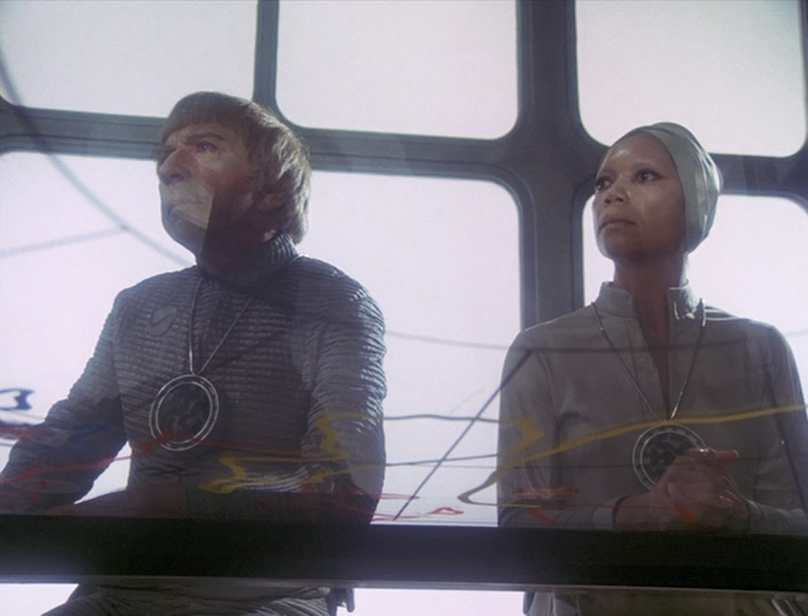
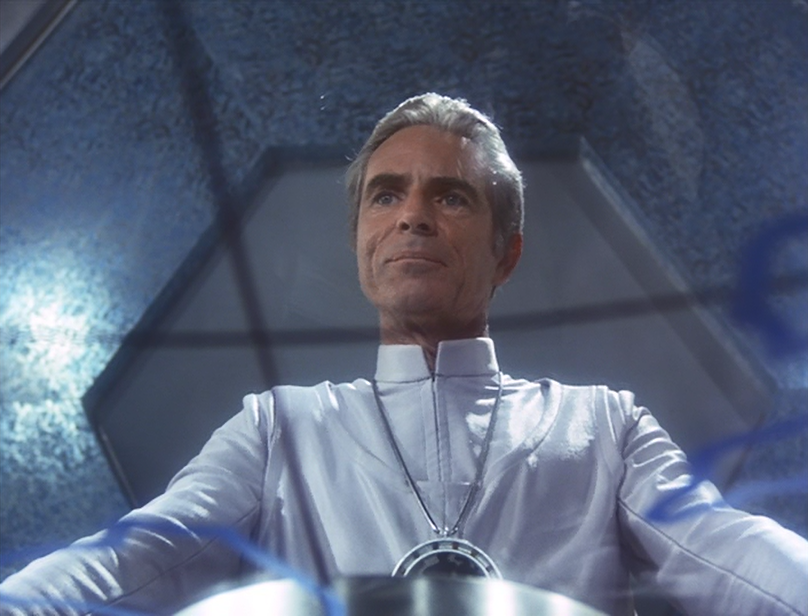
In the first scene, a council in "an uncharted solar system in the vast regions of outer space" discusses Earth.  After learning that the people of Earth are "just beginning to develop" atomic weapons and that they have wars, Sakri - a member of the council - says, "I vote we sterilize this Earth now," reasoning that once they develop space flight, "they become a threat to every civilized planet."  Gorel - an-other member of the council - is "inclined to agree with Sakri."  Andros, who has been been observing Earth and informing the council about it, asserts that according to the council's laws, "Before any action on a primitive planet, there must be a judgment."  Andros is sent back to Earth to observe and to "convince the council that they deserve a chance to survive, to grow."

Throughout this conversation, all of the camera angles are looking upward, through a clear table:


The perspectives are such that as the council is discussing what will happen to Earth, the audience has to look up at its members.  The camera angles clearly illustrate that the council is in control and has the power, and that we - the Earth-born audience - are subject to it and its decision.

Saturday, August 8, 2020

Jaws

I recently watched Jaws and noticed a small feature in one of the shots.  After three people have been killed in shark attacks, Chief Brody tries once again to convince the mayor to close the beaches in order to prevent more incidents.  The mayor stubbornly refuses, thinking that he's taking the best course of action for the sake of the town's businesses, which depend on summer tourism.  He says, "Tomorrow's the Fourth of July, and we will be open for business.  It's gonna be one of the best summers we've ever had.  Now, if you fellas are concerned about the beaches, you do whatever you have to to make them safe, but those beaches will be open for this weekend."  With that, he gets in his car and drives away.  Behind him, there's a road sign that reads, "One way."


To some degree, this sign echoes the mayor's obstinacy.  He's determined not to allow anything other than what he wants.  Additionally, Brody's facing the opposite direction illustrates this conflict visually.