Saturday, April 16, 2022

The Lion King

I recently re-watched The Lion King for the first time in many years, and I noticed some significant visual contrasts. 

Near the beginning of the movie, there's a shot of Rafiki holding up Simba in the sunlight on Pride Rock before all of the animals in the kingdom:


Later, there's a contrasting shot of Pride Rock.  Instead of day, it's night; instead of sunlight, the moon is in the background; and instead of the various animals of the kingdom, there are only hyenas:


Visually, this illustrates the difference between Mufasa's reign and Scar's reign.  Near the end of the movie, after Simba has been restored as king, his heir is also held up by Rafiki.  The specific shot composition doesn't match, but it is in the daylight and before the animals in the kingdom, so there's a contrast again, this time between Scar's reign and Simba's reign.

These contrasts also show visually what Mufasa tells Simba near the beginning of the movie: "Everything the light touches is our kingdom.  A king's time as ruler rises and falls like the sun.  One day, Simba, the sun will set on my time here and will rise with you as the new king."  In between the sunlit reigns of Mufasa and Simba, there's the darkness of Scar's reign.

An-other contrast is in the color.  At the beginning of the movie, during Mufasa's reign, the colors are vibrant, but during the worst point of Scar's reign, when there's no food or water, the landscape is almost devoid of color, mirroring this lifelessness:


After Simba is restored as the rightful king, there's a revival, and the proliferation of colors returns:


The colors illustrate this change from prosperity to desolation and then back to prosperity.

Both of these contrasts (the day/night shots of Pride Rock and the change in color) also demonstrate the cyclical theme of the movie ("the circle of life").

Saturday, March 12, 2022

THX 1138

Earlier this week, I re-watched THX 1138 in order to confirm something I'd suspected based only on my recollections.  For the majority of the film, the color scheme is subdued; it's mostly white, gray, or black and comprised only of artificial elements.  The final shot, in which the title character emerges from the ground in front of a sunset, is completely opposite:


Instead of muted colors, there's a very bright orange, and it's a natural setting (with birds flying across the sky, even), rather than the man-made environments seen previously.  The stark contrast between this single shot and everything that comes before it visually illustrates THX's breaking free from a very regulated society.

I also noticed that the soundtrack for this scene is the first movement from Bach's St. Matthew Passion.

For what it's worth:  years ago, I discovered that part of the Yardbirds' "Still I'm Sad" is used in the soundtrack near the beginning of Electronic Labyrinth THX 1138 4EB, George Lucas's student film that's the basis for THX 1138.

Saturday, February 12, 2022

Click

I recently re-watched Click for the first time in many years, and I found a couple interesting features to note.

Here's a summary of the plot:  Michael Newman is an architect who feels he needs to impress his boss in order to get a better position at work.  More and more, he's occupied with work obligations rather than spending time with his family.  Frustrated with the number of remote controls in his house, he goes out to buy a universal remote control in order to simplify his life, and he eventually gets one for free from Morty in the "way beyond" section of Bed, Bath, and Beyond.  He soon discovers that along with controlling his television, this universal remote can control the world around him, and before long, he's fast forwarding through traffic and arguments with his wife and skipping forward until his illnesses have cleared up or he's received a promotion at work.  Learning from his behavior, the programming on the remote begins to take over, and Newman finds that he's skipping too much.  His children grow up so quickly that he doesn't recognize them; his wife divorces him; and he learns of his father's death years after it happens.  After sustaining what is apparently a heart attack at his son's wedding, he finds himself on his death bed but manages to summon enough strength to run outside and tell his son that family comes first.  He dies but wakes up to find that he's still in Bed, Bath, and Beyond and that the whole adventure with the remote was a dream.

After he finds out that his father has died, Newman visits his gravestone.  Morty shows up (as he's done a few other times when Newman has questions about the remote and what it can do), tells him, "I'm sorry about your father.  Taking him wasn't something I wanted to do," and reveals that he's the angel of death.  Morty's name is an indication of his position; it's a nod to mors (genitive mortis), the Latin word for death.  Furthermore, in the same way that the diminutive name "Morty" is only a fraction of the true mortis, Newman's own death is merely part of his dream, not a genuine death.

As the remote gains a stronger hold on Newman's life, the color palette of the film gradually moves away from warm colors and towards cool colors (particularly gray, white, and blue), especially once he becomes CEO of the architectural firm.  This shift in color symbolizes two things:  first, that as he skips over events, Newman's life becomes progressively less enjoyable and less vivid.  Second, since the cooler color scheme matches the appearance of the remote itself (which is blue and silver), this shift illustrates the device's growing dominance over Newman's life.

Saturday, January 15, 2022

Star Wars - Episode III: Revenge of the Sith

In re-watching The Clone Wars yet again, I recently watched the DVD featurette on the Zillo Beast story arc (episodes 18 and 19 of season 2).  Kilian Plunkett, one of the designers, explains that the Zillo Beast arrives on Coruscant at the same military staging area seen in Revenge of the Sith.  There are a few clips from the movie to illustrate this, and one of them shows a Jedi cruiser flying overhead:


I realized that this has a sort of reverse parallelism with a shot near the beginning of A New Hope, where a Star Destroyer passes over the camera in the opposite direction:


The similarity of these two shots may be coincidental, but the fact that the ships are in the same position relative to the camera while going in opposite directions does illustrate the contrast between these two time periods.  At this point in Revenge of the Sith, there are still Jedi working towards peace and justice in the Republic, but by the time of A New Hope, they're "all but extinct" in the "dark times" of the Empire, as Obi-Wan tells Luke.

---&---

Last year, I realized a connection between the names of the Sith lords in Star Wars and their characters.  Since Revenge of the Sith is the movie with the most Sith lords (Tyrannus, Sidious, and Vader) and deals the most with their nature, I thought I'd add this point here too.

Most of the names of the Sith lords come ultimately from Latin.  Maul is from molere, which means to grind.  Tyrannus is the Latin word for tyrantSidious seems to come from insidious, which is from the Latin insidiae, which means ambush or trickery.  Even Plagueis, who is only mentioned, has a Latinate name; it's similar to plague, which comes from plangere, to beat or to strikeVader is the exception.  While it's pronounced differently, vader is the Dutch word for father.

In the same way that Vader's name comes from a different language family, his motivation for becoming a Sith lord is different from the others'.  Sidious's goal is clearly the acquisition and maintaining of power.  ("Unlimited power!")  The motivations of Maul and Tyrannus really aren't explored to a great degree, but they seem similar to Sidious's.

Vader, on the other hand, throws in his lot with Sidious and becomes a Sith lord primarily to save Padmé from his premonitions of her death.  He does want power (over death), but his desire for power isn't a selfish one like Sidious's is.

Saturday, November 20, 2021

Star Wars: The Clone Wars - S2E15 - "Senate Murders"

This post contains spoilers.

In my latest re-watch of The Clone Wars, I recently watched "Senate Murders" and noticed some significant lighting in the climactic scene.

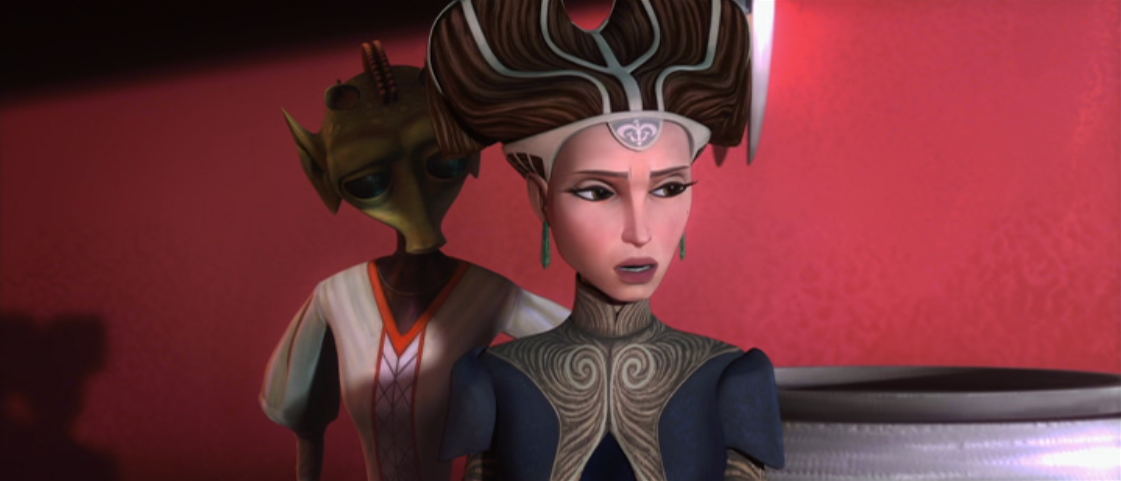
Lieutenant Divo suspects Senator Burtoni for the murders of Senator Farr and Senator Deechi, partially because the poison that killed Farr was developed by Kaminoans and Burtoni is a Kaminoan.  When Divo mentions that the poison affects only Rodians, however, Senator Amidala notes an inconsistency:  if the poison affects Rodians and the senatorial party all drank the poisoned drinks, Lolo would have been poisoned too.  As Amidala is considering this, Lolo is standing behind her, covered by her shadow:


As Amidala remembers that Lolo didn't drink, Lolo steps out from behind her, pulls a blaster on Amidala, and admits to the murders:


Lolo's standing in the shadow here represents two things.  On a simple level, it shows that she's trying to avoid the scrutiny of the investigation, but, more metaphorically, it also illustrates that her involvement has been obscured while Divo has been conducting his investigation and Amidala and Senator Organa have been doing their own.  None of them considered Lolo as a suspect until this moment, and when she steps out into the light, she reveals everything.  The shadow she's hiding in represents the characters' ignorance.

Saturday, November 13, 2021

Star Wars: The Clone Wars - S2E14 - "Duchess of Mandalore"

After a bit of an unintentional break, I'm back to re-watching The Clone Wars.  I'd noticed before that in "Duchess of Mandalore," Duchess Satine doesn't accept the helping hand that one of her guards extends to her as she gets into her speeder, but when I watched the episode recently, I realized that this detail has significance.


Satine's not accepting her guard's help visually illustrates how extreme her independence has become.  Later, Obi-Wan confronts her about this:  "You need your friends with you, not held at arm's length.  In your quest to be self-reliant have you decided to cut your friends out of your life?"

Saturday, October 16, 2021

Star Wars: The Clone Wars - S2E13 - "Voyage of Temptation"

Even before I got to season two of Star Wars: The Clone Wars in re-watching the show, I was thinking about the episode "Voyage of Temptation."  When I re-watched it recently, I was able to confirm what I'd suspected.

For most of this episode, Duchess Satine is wearing an elaborate headdress:


When Tal Merrick* takes her hostage, however, he knocks her headdress off:


When it appears as if Merrick is going to escape with her as his prisoner, Satine confesses her love for Obi-Wan:  "Obi-Wan, it looks like I may never see you again.  I don't know quite how to say this, but I've loved you from the moment you came to my aid all those years ago."

Satine's headdress represents the hidden nature of her feelings.  Only after it's been dislodged are they exposed.

---
*There's some discrepancy in how Merrick's name is spelt.  In the credits, it's Merrick, but on the Star Wars website, it's Merrik.